About the Ansonia “Relay” Clock
Title: Ansonia “Relay” Clock Model: A Collector’s Delight
The Ansonia “Relay” clock, produced between 1895 and 1920, is a captivating mantel clock that graced many Victorian homes during the Belle Époque era. This exquisite timepiece, a testament to Ansonia Clock Company’s craftsmanship, is one of their most sought-after designs among antique clock collectors.
The Relay clock showcases an intricate brass case with a unique design that combines elegance and innovation. The case is adorned with delicate floral motifs, often featuring openwork patterns that highlight the craftsman’s skill. The dial, typically white enamel with black Roman numerals, adds a touch of sophistication to the overall design.
What sets the Ansonia Relay clock apart as a collectible piece is its exceptional mechanical movement and innovative features. One such feature is the relay mechanism, which allowed for the striking of hours and half-hours only, making it quieter than traditional clock models. Additionally, the Relay’s pendulum, suspended within a glass globe, serves not only as a functional component but also as an aesthetic centerpiece.
Notable features of the Ansonia “Relay” clock include its keyless wind design for convenience and the presence of a subsidiary seconds dial, enhancing the clock’s precision and appeal. With its intricate design, innovative mechanism, and historical significance, the Relay clock continues to captivate collectors worldwide, making it an essential addition to any serious antique clock collection.
Auction Records and Price History
The following 3 auction record(s) show actual sale prices for the Ansonia “Relay” model clock. Prices vary based on condition, originality, and current market demand. Search for more records on AntiqueClocksPriceGuide.com.
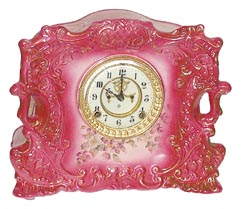
Ansonia Clock Co. Royal Bonn porcelain clock, “Relay”, ca 1904.
This is a bright pink case, pink flowers on all sides and top, a lot of gold, making this a very attractive case. One of the large cases being 13 1/2 inches wide, 11 1/4 inches high. Open places on each side making it very different. There is a small sliver off on the rear bottom, and a place on top the size of a match head that could be touched with fingernail polish. Both places hardly noticeable. This may not be a clock for the purists who are attempting to collect a set of perfect Ansonia porcelain or Royal Bonn clocks. Very nice 2 piece porcelain dial, open escapement in the center. 8 day, half hour gong strike, a good runner, pendulum is not original but Timesavers can remedy that. Ly-Ansonia No.2591.
Sold: $575 | Date: 1/1/2003 | Source: Horton’s Antique Clocks
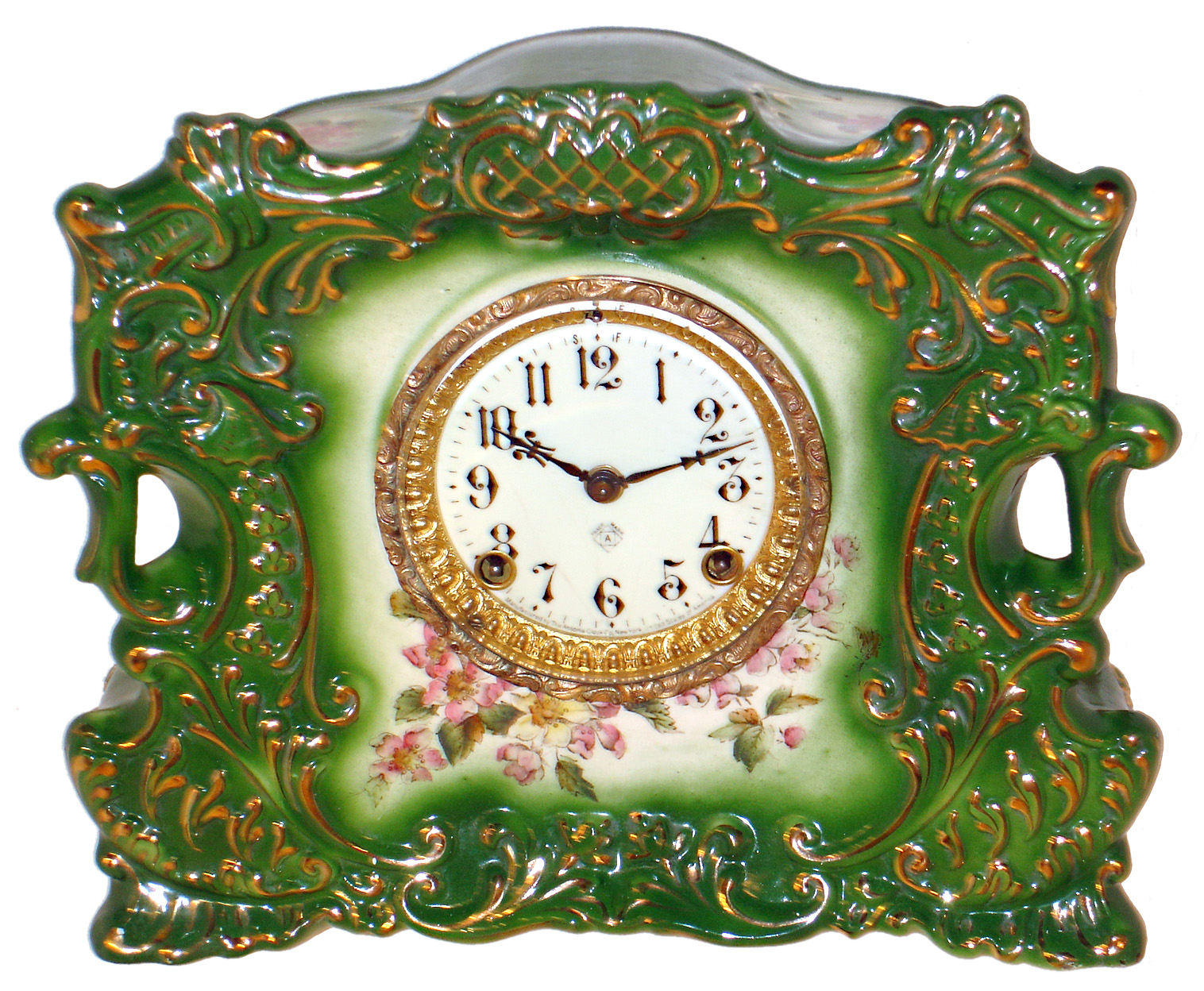
Ansonia Clock Co., New York, “Relay” porcelain 8 days, time and strike, mantel clock, c1904
the case is in very good condition, with a few small damaged areas, some paint specks on top and the expected light crazing of the fired surface. The porcelain dial has faint hairlines, The beveled glass has some minor interior edge chips. The movement and case back are correctly signed. Ht 11″
Sold: $100 | Date: April 27, 2014 | Source: R. O. Schmitt Fine Arts
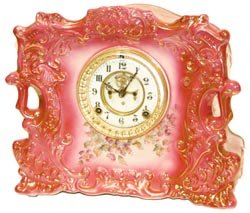
Ansonia Clock Co. porcelain cased, “Relay”, C. 1904.
This is a large clock that is 13.5″ wide and 11.25″ high. I know it isn’t one of the La whatever, but it is a very stylish and colorful case, clean as a pin, shining all over, brass shining. All Ruby, even the flowers are darker than most, but an abundance, and some would say an overabundance of gold striping. Note the open pretzel looking things on the sides. Outstanding 2 piece porcelain dial, open escapement, hands, thick beveled glass in the French style, machined bezel, and American sash. Completely original but with a couple of small imperfections; a place on the top the size of a match head that must have been a chip, now touched up with paint; a sliver on the back bottom edge is missing. Neither of the imperfections can be seen unless you are trying to find them. 8 day movement, strikes half hours on a gong, runs good, has a correct pendulum and back door. Ly-Ansonia #2591.
Sold: $0 unsold | Date: July, 2004 | Source: Horton’s Antique Clocks